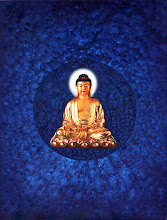
The Geneva-based International Coalition for the Advancement of Religious and Spirituality (ICARUS) has bestowed "The Best Religion in the World" award this year on the Buddhist Community.
This special award was voted on by an international round table of more than 200 religious leaders from every part of the spiritual spectrum. It was fascinating to note that many religious leaders voted for Buddhism rather than their own religion although Buddhists actually make up a tiny minority of ICARUS membership. Here are the comments by four voting members: Director of Research for ICARUS Jonna Hult, said "It wasn't a surprise to me that Buddhism won Best Religion in the World, because we could find literally not one single instance of a war fought in the name of Buddhism, in contrast to every other religion that seems to keep a gun in the closet just in case God makes a mistake. We were hard pressed to even find a Buddhist that had ever been in an army.
These people practise what they preach to an extent we simply could not document with any other spiritual tradition." Tribune de Geneve
Saturday, August 8, 2009

Friday, August 7, 2009
Economic assistance to weaker sections: Mayawati
Lucknow : Uttar Pradesh Government will provide economic assistance to people belonging to backward classes, weaker sections, minorities and poor people of upper castes, Chief Minister Mayawati said.Keeping this in view, arrangements had been made to provide monetary help to educationally, socially and economically backward sections, she said.The CM made the announcement recently while reviewing progress of various welfare schemes being implemented by the Backward Classes Welfare Department.Directing officers to distribute scholarship among students of the backward classes, Maywati said a sum of Rs 83,933.78 lakh had been arranged for this purpose this year. As many as 1,90,58,236 students would be beneficiaries.Rs 716.52 lakh had been allocated to construct 14 hostels during 2009-10 to provide housing facilities to poor students of backward classes.The government had raised the limit of creamy layer to Rs 5 lakh, making a large number of students beneficiaries.
Elephant row a conspiracy:BSP
Lucknow: The Bahujan Samaj Party (BSP) has said the controversy over its election symbol, elephant, had been raked up by opposition parties with vested interests.
In a release on Wednesday, party general secretary Satish Chandra Misra said it was a "political conspiracy". However, opposition leaders continue to lambaste the BSP on the issue.
Misra was reacting to the notice issued to the BSP by the Election Commission (EC) which is looking into a petition about the Mayawati government allegedly misusing government money to put up statues of elephants. The BSP has been asked to reply by August 12.
"In Indian culture, elephants have been a symbol of welcome and good luck for ages," Misra said. "The statues of elephants installed in parks and memorials in Uttar Pradesh are different from the elephant depicted in the party's election symbol," he said.
Misra pointed out that the trunks of the elephants in the statues were curled up in the air as a form of salutation or greeting, while the trunk of the elephant in the party's election symbol was hanging towards the ground. "We have made our position clear in this regard to EC earlier also," he said.
"Opposition parties threatened by the BSP's increasing popularity and power have fuelled this controversy for cheap publicity. The BSP is not the least affected by such tactics."
Misra said "Elephant Parks" had been constructed at several places in UP in previous regimes as well. "Statues of elephants saluting visitors at the gates of Raj Bhavans, Rashtrapati Bhavan and several temples across the country have never evoked controversy... it's a ridiculous issue being raked up unnecessarily," he said.
Misra also pointed out that other parties had erected museums, memorials and mausoleums in memory of their leaders. "But when we build memorials, opposition leaders start having problems... it amounts to disrespect to the great Dalit and backward leaders in whose memory the BSP is building memorials," he said.
Misra said the Mayawati government had been giving out bicycles to poor girl students. "But no one ever raised any objection, saying the cycle is the Samajwadi Party's election symbol," he quipped.
SP leader Shivpal Singh told reporters the Mayawati government was squandering funds on putting up elephant statues when she should be concentrating on drought relief. "The BSP's recognition as a national party should be withdrawn immediately," he said. He has demanded a CBI inquiry into the alleged misuse of funds for building parks and memorials.
Congress leader Vivek Singh said funds from central schemes were being used for building parks and memorials and installing statues. "At a time when farmers are committing suicides, all Mayawati can think of is putting up her own statues and those of elephants... hundreds of crores of government funds are being used to popularise a party."
Seminar on Dalit welfare in Udipi, Karnataka
Seminar on Dalit welfare
Udupi: The Dalit Sangharsh Samiti (DSS) will conduct a seminar titled “Khairlanji”, which will focus on matters such as status as well as issues facing the Dalit community in the country, here on August 9.
In a press release here on Wednesday, DSS district convener Jayan Malpe said four members belonging to the Dalit community were beaten to death by “caste” Hindus at Khairlanji village in Maharashtra in 2006. This showed that “barbarism and cruelty” against the Dalit community still prevailed in the country. “Khairlanji” was not just the story of a village but the story of the Dalit people as well, he added. ‘Necessary’
It had become necessary to understand the headway being made by various progressive movements and to formulate steps to be taken to prevent caste atrocities. It was also necessary to understand the caste system and its influence on democracy, civil society and the media. All these issues would be discussed at the seminar.
Writer Shivasundar will inaugurate the event
Thursday, August 6, 2009
Indian Dalits hate Mohandas Gandhi. Why?
by Moin Ansari
Why do India’s Dalits hate Gandhi? By Thomas C. Mountain
In India, supposedly the world’s largest democracy, the leadership of the rapidly growing Dalit movement have nothing good to say about Mohandas K. Gandhi. To be honest, Gandhi is actually one of the most hated Indian leaders in the hierarchy of those considered enemies of India’s Dalits or “untouchables” by the leadership of India’s Dalits.
Many have questioned how could I dare say such a thing? In reply I urge people outside of India to try and keep in mind my role as the messenger in this matter. I am the publisher of the Ambedkar Journal, founded in 1996, which was the first publication on the Internet to address the Dalit question from the Dalits’ viewpoint. My co-editor is M. Gopinath, who includes in his c.v. being managing editor of the Dalit Voice newspaper and then going on to found Times of Bahujan, national newspaper of the Bahujan Samaj Party, India’s Dalit party and India’s youngest and third largest national. The founding president of the Ambedkar Journal was Dr. Velu Annamalai, the first Dalit in history to achieve a Ph.d in Engineering. My work with the Dalit movement in India started in 1991 and I have been serving as one of the messengers to those outside of India from the Dalit leaders who are in the very rapid process of organizing India’s Dalits into a national movement. The Dalit leadership I work with received many tens of millions of votes in the last national election in India.
With that out of the way, lets get back to the 850 million-person question, why do Dalits hate M.K. Gandhi?
To start, Gandhi was a so-called “high caste”. High castes represent at small minority in India, some 10-15 percent of the population, yet dominate Indian society in much the same way whites ruled South Africa during the official period of Apartheid. Dalits often use the phrase Apartheid in India when speaking about their problems.
The Indian Constitution was authored by Gandhi’s main critic and political opponent, Dr. Ambedkar, for whom our journal is named and the first Dalit in history to receive an education (if you have never heard of Dr. Ambedkar I would urge you to try and keep an open mind about what I am saying for it is a bit like me talking to you about the founding of the USA when you have never heard of Thomas Jefferson).
Most readers are familiar with Gandhi’s great hunger strike against the so called Poona Pact in 1933. The matter which Gandhi was protesting, nearly unto death at that, was the inclusion in the draft Indian Constitution, proposed by the British, that reserved the right of Dalits to elect their own leaders. Dr. Ambedkar, with his degree in law from Cambridge, had been chosen by the British to write the new constitution for India. Having spent his life overcoming caste-based discrimination, Dr. Ambedkar had come to the conclusion that the only way Dalits could improve their lives is if they had the exclusive right to vote for their leaders, that a portion or reserved section of all elected positions were only for Dalits and only Dalits could vote for these reserved positions.
Gandhi was determined to prevent this and went on hunger strike to change this article in the draft constitution. After many communal riots, where tens of thousands of Dalits were slaughtered, and with a leap in such violence predicted if Gandhi died, Dr. Ambedkar agreed, with Gandhi on his death bed, to give up the Dalits right to exclusively elect their own leaders and Gandhi ended his hunger strike.
Later, on his own death bed, Dr. Ambedkar would say this was the biggest mistake in his life, that if he had to do it all over again, he would refuse to give up Dalit only representation, even if it meant Gandhi’s death.
As history has shown, life for the overwhelming majority of Dalits in India has changed little since the arrival of Indian independence over 50 years ago. The laws written into the Indian Constitution by Dr. Ambedkar, many patterned after the laws introduced into the former Confederate or slave states in the USA during reconstruction after the Civil War to protect the freed black Americans, have never been enforced by the high caste dominated Indian court system and legislatures. A tiny fraction of the “quotas” or reservations for Dalits in education and government jobs have been filled. Dalits are still discriminated against in all aspect of life in India’s 650,000 villages, despite laws specifically outlawing such acts. Dalits are the victims of economic embargos, denial of basic human rights such as access to drinking water, use of public facilities and education and even entry to Hindu temples.
To this day, most Indians still believe, and this includes a majority of Dalits, that Dalits are being punished by God for sins in a previous life. Under the religious codes of Hinduism, a Dalit’s only hope is to be a good servant of the high castes and upon death and rebirth they will be reincarnated in a high caste. This is called varna in Sanskrit, the language of the original Aryans who imposed Hinduism on India beginning some 3,500 years ago. Interestingly, the word “varna” translates literally into the word “color” from Sanskrit.
This is one of the golden rules of Dalit liberation, that varna means color, and that Hinduism is a form of racially based oppression and as such is the equivalent of Apartheid in India. Dalits feel that if they had the right to elect their own leaders they would have been able to start challenging the domination of the high castes in Indian society and would have begun the long walk to freedom so to speak. They blame Gandhi and his hunger strike for preventing this.
So there it is, in as few words as possible, why in today’s India the leaders of India’s Dalits hate M.K. Gandhi.
This is, of course, an oversimplification. India’s social problems remain the most pressing in the world and a few paragraphs are not going to really explain matters to anyone’s satisfaction. The word Dalit and the movement of a crushed and broken people, the “untouchables” of India, are just beginning to become known to most of the people concerned about human rights in the world. As Dalits organize themselves and begin to challenge caste-based rule in India, it behooves all people of good conscience to start to find out what the Dalits and their leadership are fighting for. A good place to start is with M.K. Gandhi and why he is so hated by Dalits in India.
Thomas C. Mountain is the publisher of the Ambedkar Journal on India’s Dalits, founded in 1996. His writing has been featured in Dalit publications across India, including the Dalit Voice and the Times of Bahujan as well as on the front pages of the mainstream, high caste owned, Indian press. He would recommend viewing of the film “Bandit Queen” as the best example of life for women and Dalits in India’s villages, which is the story of the life of the late, brutally murdered, Phoolan Devi, of whose international defense committee Thomas C. Mountain was a founding member. He can be reached at tmountain@hawaii.rr.com. Online Journal, Email Online Journal Editor source: Pakistan daily
Buddhism is fastest-growing religion in English jails
Martin Beckford : Although adherents to the Eastern faith believe in peace and the sanctity of life, almost all of the Buddhists behind bars in this country are serving lengthy sentences for serious crimes such as violence and sex offences.
Some jails and secure hospitals including Broadmoor have opened shrines known as Buddha Groves in their grounds, and there is a nationwide network of chaplains to cater for the growing population.
It is claimed that most of the Buddhists in jail converted after their conviction, and chose it over other religions because its emphasis on meditation helps them cope with being locked up.
Supporters of Buddhist criminals say they also believe the spiritual development they gain in prison will help them once they are released, and prevent them from re-offending.
Lord Avebury, a Liberal Democrat peer who is the patron of Angulimala, the Buddhist Prison Chaplaincy Organisation, told The Daily Telegraph: "The numbers are quite remarkable. I think one of the reasons is that they convert to Buddhism in prison – it's a reasonable hypothesis that they become interested when inside.
"I think it does enable people to come to terms with their situation. Buddhism gets people away from the idea of material ambitions, and if people are in prison they can't go for those goals anyway.
"You do have more time to reflect and meditate in jail, and get away from the idea of self."
He went on: "My inclination would be to say it must help people after they leave jail. The whole idea of Buddhism is not to cause harm to anybody, and the person who persists in their faith is likely to be totally recast in their life and must be less likely to re-offend."
Lord Avebury said the care offered by the network of Buddhist prison chaplains, who are supported by the Prison Service, would also have encouraged many prisoners to convert, in addition to the existence of shrines in the jail grounds.
"We have an annual celebration at Spring Hill [an open prison in Buckinghamshire where the first Buddha Grove was built]. That's a remarkable place, it's extremely peaceful. Staff go there to meditate as well as prisoners."
Official figures show Britain's 149,157 Buddhists – who believe in gaining spiritual knowledge about the true nature of life and do not worship gods – make up just 0.26 of the general population .
In 1997 there were only 226 Buddhists in prisons in England and Wales, but by the end of June 2008 that figure had risen by 669 per cent to reach 1,737 – 2 per cent of the 79,734 prison population.
The vast majority, 1,194, were white and most were over 30. Only 78 were female.
Detailed statistics published by the Ministry of Justice show that almost all were serving long sentences. In total, 621 were serving terms of four years or more, while a further 521 had been given indeterminate sentences.
The rate of growth in the Buddhist jail population outstrips that of Muslims, whose numbers have more than doubled from 3,681 to 9,795 over the past 11 years.
Christians remain the best represented group behind bars, with 41,839 worshippers, while those declaring themselves to have no religion, or atheist or agnostic views, now stand at 27,710.
Atheists make up 1 per cent of the prison population for the first time this year, with 570 declared adherents to the view that there is definitely no God.
Just 220 prisoners said they were Jewish – fewer than the 366 recorded Pagans, 340 Rastafarians and 230 Jehovah's Witnesses. There are also 37 members of the Salvation Army in jail.
A Prison Service spokesman said: "The Prison Service recognises the positive role faith can play in the lives and rehabilitation of prisoners, and is committed to enabling prisoners of all faiths to practise their religion.
"Each prison has a multi-faith chaplaincy team to meet the religious and pastoral needs of prisoners and staff. Teams include chaplains and volunteers from a wide range of religions and denominations."
Population in English and Welsh prisons by religion in June 2008
No religion 26,626
Church of England 23,039
Roman Catholic 14,296
Muslim 9,795
Buddhist 1,737
Sikh 648
Atheist 570
Agnostic 514
Hindu 434
Pagan 366
Rastafarian 340
Jehovah's Witness 230
Jewish 220
Scientology 3
Source: Ministry of Justice
Works on full swing to complete Sakyamuni project by 2010
SE-GANGTOK, August 5: The installation of the 130 feet tall Buddha Statue for Sakyamuni project at Rabong in South Sikkim is expected to take one more year with architects and sculptors working dedicatedly at the base camp of Sangkhola near Singtam in East Sikkim.The statue of Lord Buddha is being designed in a sitting position at a height of 95 feet. The total height of the statue will reach up to 130 feet after adding the base and throne making the statue on of the tallest Buddha statue in the world.During a visit to the Sangkhola camp, the media team found architects and sculptors engaged with various components of the upcoming statue.For the last two years, twenty persons engaged for the statue have been working for over 12 hours daily to complete the statue expected to be completed and installed at Rabong within the next 12 months.Out of these workers, eight are from Jaigoan and twelve from Kathmandu.Krishna Khati, a metal worker at the construction site at Sanghkhola said that the statue with an aluminum bronze alloy steel frame will weigh over 57 tons after its completion.After assembling the whole statue, the structure will again be dismantled into pre-fabricated sizes and shape for a smooth transfer to Rabong where it will be installed.It may be recalled that the work on the 130 feet Buddha statue project started in 2006, the year which marked the 2550th birth anniversary of Lord Gautama Buddha.The State government in a policy decision had decided to observe the birth anniversary throughout the year in Sikkim and as part of the celebrations, an initiative was being taken by the people of Rabong to construct and install a large statue of Lord Buddha and eco -garden to commemorate the event.Slated to be a landmark in Sikkim’s unique effort in uniting tourism and religion, the project has Chief Minister Pawan Chamling as its chief patron.Former urban development minister DD Bhutia is overseeing the project as its patron.The Sakyamuni project in Rabong covers an area of 22.4 acres with its own eco-garden, tourist amenities along with the giant Buddha statue.The project has already received international attention much in advance with thirteen relics of Lord Buddha from 13 different countries being handed over to the Sakyamuni project last year in November.The relics were handed over for the Sakyamuni project at the new Karma Thekchenling monastery at the Mane Chokerling complex at Rabong by the team of Thai monks led by the Venerable Jamnian Chonsakhorn Seelasettho, the chief of priests of the Thai monastery leading the delegation.The relics had been offered by Somdet Phra Nyanasaamvara, the 19th Supreme patriarch of the kingdom of Thailand.Following the request, a high Thai priest Venerable Phra Kristada of Bangkok had agreed to be the representative of the Sakyamuni project for securing the most precious relics from all the neighbouring Buddhist countries. The relics have been offered from Thailand, Burma, Japan, South Korea, Cambodia, Laos, Taiwan, Vietnam, and Buddhist temples in California, Germany, Lumbini in Nepal and Bodhgaya in India for the Sakyamuni project.
Subscribe to:
Posts (Atom)